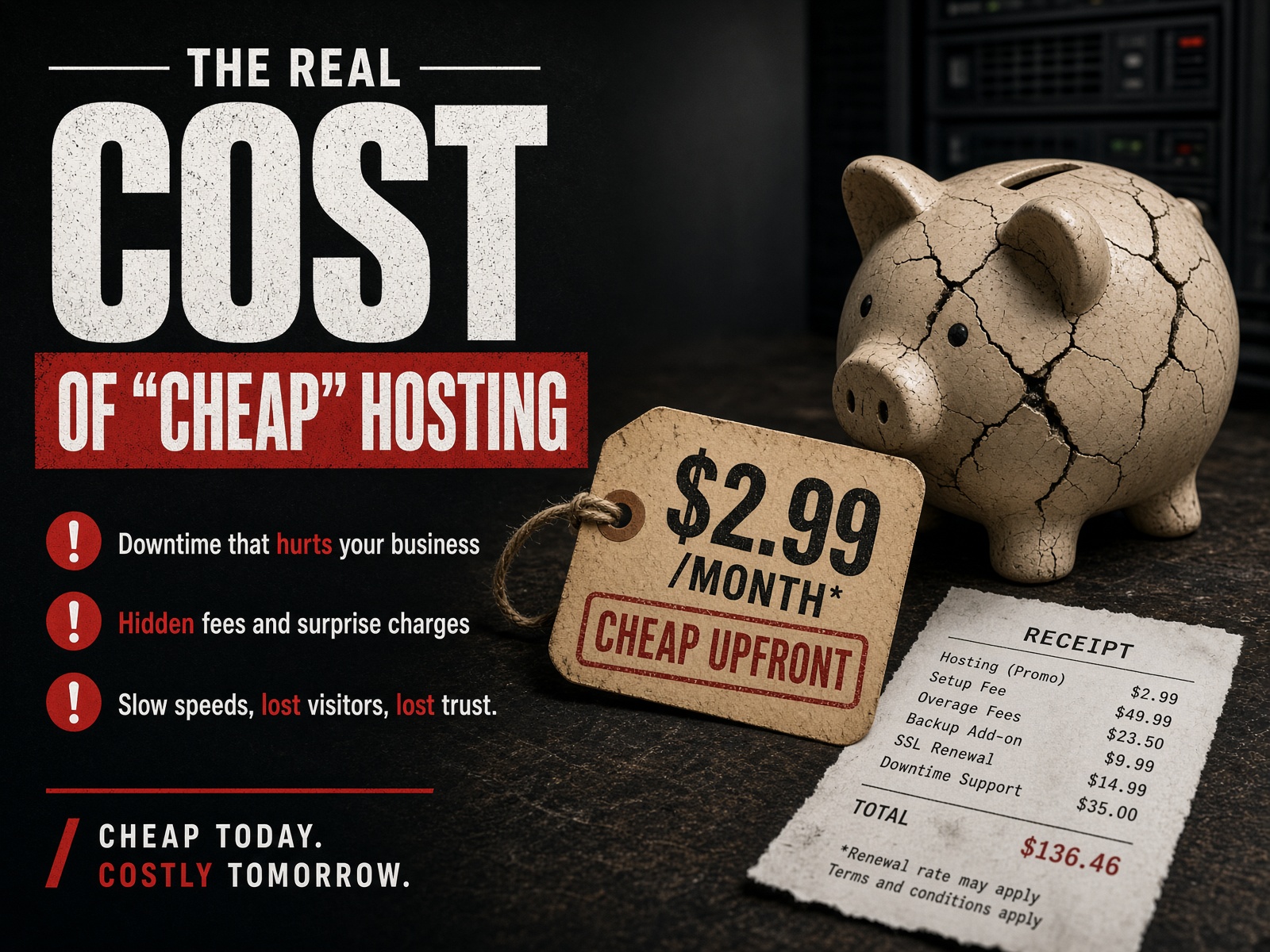
You can find web hosting for three or four dollars a month. It looks like a great deal until you start counting what it actually costs.
Most of the rock-bottom hosts make their money on the upsells. The basic plan is cheap. Then you need daily backups. That’s extra. SSL certificate? Extra. Email that doesn’t go to spam? Extra. Staging site so you can test changes? Extra. Real support that answers the phone instead of a ticket system? That’ll be the “premium” plan. Before long the cheap host is the same price as a better one, except now you’re stuck with slower servers and support that takes days to reply.
There’s also the time cost. When your site goes down on a Saturday in July and you’re dealing with a support ticket that says “we’ll get back to you within 48 hours,” that’s not free. When the site crawls because the server is overloaded and people leave before the page finishes loading, that’s not free either. And when you finally decide to leave and discover the migration process is a nightmare, that costs more time and money.
We’ve seen the pattern enough times. A business moves to a cheap host to save a few dollars. Six months later the site is slow, the backups are incomplete, the email is unreliable, and nobody can get a straight answer when something breaks. Then they call us to clean it up and move it somewhere that actually works.
Our hosting is $14.99 a month. That’s it. Security, daily backups, SSL, email on your own domain, unlimited bandwidth, and human support. No nickel-and-diming. No “business plan” that magically unlocks the features you already need. If something goes wrong at 2 a.m. or on a holiday weekend, you can text or call and talk to a person who knows the coast and knows your site.
Is it the absolute cheapest number on the internet? No. Is it the cheapest once you add up the real costs of downtime, slow support, and constant upsells? Almost always.
A nice website on a bad host is still a problem. Speed, security, and someone who answers when it matters are not extras. They’re the baseline.
If you’re currently on a cheap host and it’s starting to feel expensive in all the wrong ways, we can look at moving you over. Most migrations are straightforward. You keep your domain, you keep your content, and you stop paying for features that should have been included from the start.